 Cliffs of Moher from Dublin
Cliffs of Moher Weather: What It Means for Your Day Trip from Dublin
Cliffs of Moher weather decides whether a day trip from Dublin delivers the view you paid for or a wall of grey fog. The cliffs stand 214 metres (702 ft) above the Atlantic on the west coast of Ireland, about 4 hours by road from Dublin via Limerick, so you cannot simply come back tomorrow if the sky turns. This guide explains the official yellow, orange and red status system that can close the site, what fog and wind do to a visit, the monthly rain and temperature averages for the area, what the tour operators say they do when conditions turn, and which months give you the best odds. The tours themselves are compared on Cliffs of Moher tours from Dublin compared.
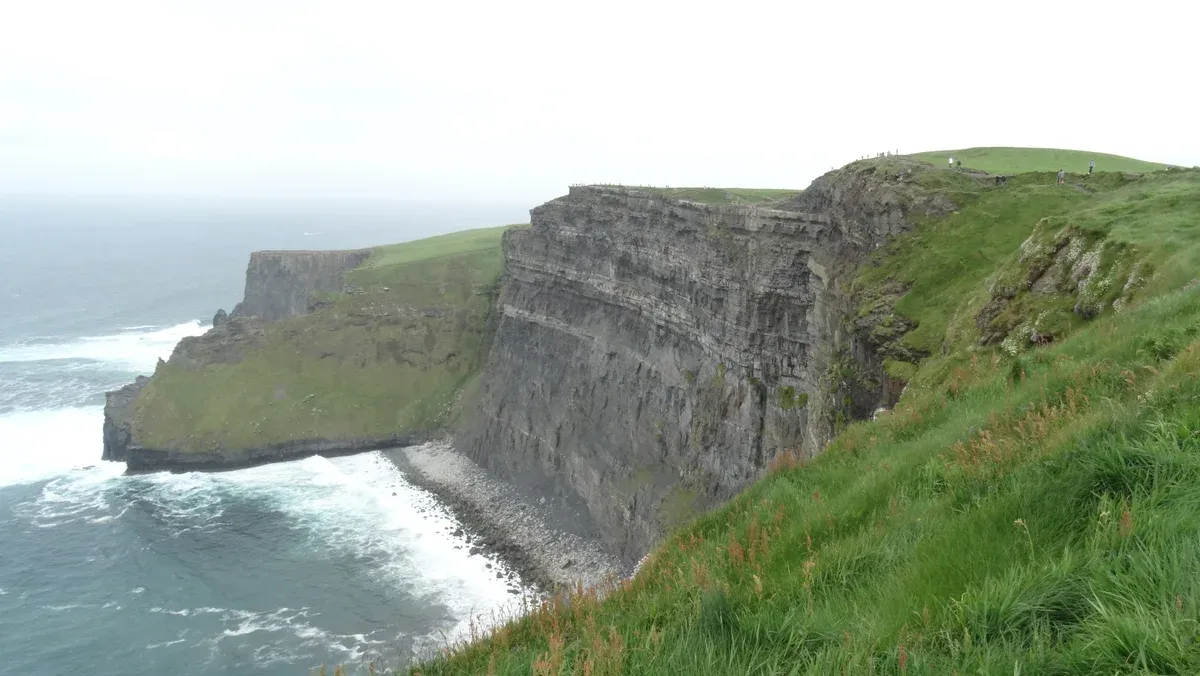
The cliffs north of O'Brien's Tower. Photo: Colin Park, CC BY-SA 2.0, via Wikimedia Commons
Quick answer The short answer
Cliffs of Moher weather is classed by the official visitor site as highly unpredictable, and the site itself is rated too hazardous to visit on an orange status and closes on a red one. April and May are the driest months, at 62.3 mm and 63.1 mm of rain over about 12 rain days, and the mean daily maximum in July is only 19.5 °C, so pack layers at any time of year. Fog is the real risk: it can hide the cliffs completely, and the official site tells visitors to check Met Éireann before travelling.
Key takeaways
- Most Dublin tours give you 80 minutes to 2 hours at the cliffs, so a foggy window matters. See how the Wild Rover Atlantic Edge day uses its 2 hours.
- The monthly climate table below shows rainfall, rain days, temperatures and sunset times, taken from Met Éireann's Shannon Airport averages.
- On an orange status the cliffs are rated too hazardous to visit, on red the visitor site closes and a coach that left Dublin at 6:45 AM cannot change that. Compare Cliffs of Moher tours from Dublin before you book.
- The boat cruise and Aillwee Cave day swaps the boat for an alternative when the sea is too rough.
Why Weather Matters More on a Day Trip from Dublin
A bad-weather morning in Dublin is an inconvenience. On the west coast it can erase the main reason you travelled.
You Cannot Pop Back Tomorrow
The cliffs sit roughly 4 hours by road from Dublin via Limerick, according to the official visitor site. Coach listings put the run at 3 to 3.5 hours each way, and the fastest motorway-only estimates of under 3 hours ignore the final stretch of two-lane road from Ennis to the cliffs. The result is a 12 to 15 hour day in which most of your time is spent travelling, and the time actually at the cliffs is 80 minutes to 2 hours on the shared-coach tours. The Cliffs of Moher, Burren and Galway Day Trip with Entry allows 80 minutes, the Cliffs of Moher, Burren and Galway City Day Tour promises a minimum of 2 hours, and the rail tour takes 15 hours door to door.
That arithmetic is why weather deserves its own page. A shower you would shrug off in a city can eat an 80-minute visit whole. Fog is worse than rain, because the cliffs can be completely invisible while you stand ten metres from the edge.
Fog: the One Forecast Line That Decides the Day
The official site describes conditions that swing from fog one minute to sun the next, and it names fog as a real feature of the clifftop rather than a rarity. The Met Éireann averages for the area record a mean of 28.3 days with fog per year at Shannon Airport, roughly one day in every thirteen. That figure is measured inland at the airport, and the clifftop, 214 metres above the Atlantic, often sits inside cloud that the airport never sees, so treat it as a floor rather than a ceiling.
There is no published fog-frequency figure for the cliffs themselves. The practical advice is simple. Check the Met Éireann forecast for Doolin or Liscannor the evening before and again in the morning, look at the cloud-base forecast rather than the rain radar, and remember that a low, grey 300-foot ceiling over County Clare usually means no view at all from the top. Rain you can walk through. Fog you cannot see through.
Wind: the Thing That Actually Closes the Site
Rain never closes the Cliffs of Moher. Wind does. The site sits on an exposed Atlantic headland, and the Met Éireann averages record a mean wind speed of 9.1 knots across the year at Shannon, with 7.5 days of gales per year. On the clifftop the gusts run harder than any airport reading.
When a status warning rises, the operator of the visitor experience can close the paths or the whole site. A coach that left Dublin at 6:45 AM, as the Finn McCools tour does from the Hugh Lane Gallery, has no plan B for a closed clifftop, which is why the status system below matters before you book, not just on the morning.
Sources: Cliffs of Moher Experience, Irish Rail fares
The Yellow, Orange and Red Status System
Met Éireann issues weather warnings at three levels, and the top two can shut the cliffs on the exact day your tour runs.
What Each Level Means for Your Visit
Ireland's national forecaster runs a three-tier warning system, and the official Cliffs of Moher site ties its own closures to it. The tiers apply to wind, rain and other hazards, but on an exposed clifftop it is the wind warnings that bite. Here is what each status means for a traveller who has already booked a coach from Dublin.
| Status | What it means | Effect on a Dublin day trip |
|---|---|---|
| Yellow | Be aware. Weather that does not pose a widespread risk to life but may affect plans | The site usually stays open. Expect strong gusts on the paths, closed tower access and a shorter or wetter visit |
| Orange | Be prepared. Weather with the potential to impact significantly | The visitor site can close. A coach already on the road may find the paths shut on arrival |
| Red | Do not travel. Dangerous weather with potential risk to life | The site closes. Access to the clifftop is shut and any visit is cancelled |
The Official Advice and the Small Print
The official visitor site recommends checking www.met.ie before travelling, and it states plainly that opening hours vary seasonally and that facilities such as O'Brien's Tower may close early for weather. Two consequences follow. First, a yellow wind warning is normal on the Atlantic coast and should not stop you travelling, but it should change what you wear and how far from the edge you walk. Second, an orange or red status on your booked day is a genuine cancellation risk, which makes the operators' own bad-weather policies, covered below, worth reading before you pay.
Specific opening hours by month are not stated in the official material we reviewed, and the site confirms only that they vary seasonally. Hour-by-hour detail belongs to the Cliffs of Moher tickets page, which covers admission and times in full.
The Coastal Path and O'Brien's Tower
The paths and the tower on an ordinary day. Third-party video by good_trips tv. We did not shoot it and have no relationship with the creator.
Monthly Climate at the Cliffs: Rain, Temperature and Daylight
The figures below are Met Éireann's 1991-2020 averages for Shannon Airport, the nearest long-record station to the cliffs, plus sunset times for Ennis around the middle of each month.
The Full Monthly Table
Shannon Airport is the closest station with a full published climate record, and the averages below are read straight from Met Éireann's table. Sunset times come from published tables for Ennis, the nearest town with published sun data to Liscannor and the cliffs. Together they answer the two questions that matter for a day trip: how wet, and how much daylight is left when a coach arrives in the afternoon.
| Month | Mean daily max °C | Rainfall (mm) | Rain days (1 mm+) | Sunset mid-month |
|---|---|---|---|---|
| January | 8.9 | 103.8 | 16.9 | not stated |
| February | 9.4 | 86.7 | 13.9 | 5:59 pm |
| March | 10.9 | 75.8 | 13.4 | 6:50 pm |
| April | 13.4 | 62.3 | 11.4 | 8:46 pm |
| May | 16.0 | 63.1 | 12.1 | 9:36 pm |
| June | 18.3 | 69.6 | 11.3 | 10:04 pm |
| July | 19.5 | 75.8 | 13.5 | 9:46 pm |
| August | 19.1 | 87.6 | 13.7 | 8:49 pm |
| September | 17.5 | 77.4 | 12.9 | 7:36 pm |
| October | 14.2 | 95.5 | 15.4 | 6:27 pm |
| November | 11.1 | 106.6 | 16.8 | 4:33 pm |
| December | 9.2 | 115.4 | 17.2 | 4:21 pm |
What the Numbers Actually Tell You
Three things stand out. First, it never gets warm: the warmest mean daily maximum of the year is 19.5 °C in July, and January manages only 8.9 °C, so a Cliffs of Moher day trip from Dublin needs a warm layer in every month of the year. Second, it is always wet somewhere nearby: even the driest month, April at 62.3 mm, still averages more than 11 rain days, and the year totals 1,019.7 mm over 168.5 days at or above 1 mm. Third, daylight swings more than temperature does. Around midsummer the sun sets after 10:00 pm, which is why an afternoon arrival at the cliffs still works. In December the sun is down by about 4:21 pm, and a coach reaching the clifftop in the afternoon would arrive in the dark, which is a practical reason the touring season thins out in winter.
Snow and sleet are rare, averaging 5.9 days a year, and fog averages 28.3 days a year at the station. None of the official averages give an hourly or clifftop-specific figure, so treat this table as the shape of the year rather than a promise for any single day.
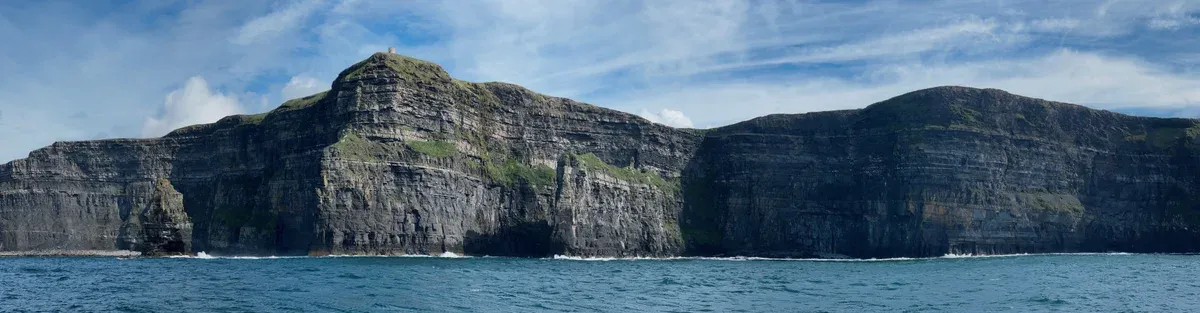
The cliff line below O'Brien's Tower, seen from a boat. Photo: Michael Candelori, CC BY 4.0, via Wikimedia Commons
What the Tour Operators Say They Do in Bad Weather
The operators cannot control the sky, but their listings state what happens when the weather spoils the main event.
The Policies Stated in the Listings
Three commitments are worth knowing before you book. The Cliffs of Moher, Burren and Galway City Day Tour from Dublin may shift time towards Galway when conditions at the cliffs are poor, so a fogged-out clifftop can at least be traded for a longer stay in a dry city. The boat cruise and Aillwee Cave day, priced at $148, swaps the boat cruise for a bird of prey show when the sea state makes sailing unsafe, which matters because the boat is the entire point of that tour and the cruise runs only from April to October. And every tour listed here carries 24-hour free cancellation, which is the single most useful weather tool you have: check the Met Éireann forecast the day before, and cancel inside the free window if an orange warning has been issued for Clare.
On the smaller risks, the sea cruise on the boat-and-cave day has a duration that varies with vessel and weather, and the Cliffs of Moher, Atlantic Edge and Galway City Day Tour already routes through Corkscrew Hill when the coast road is closed, which is a wind-driven closure that happens on this coastline. Bad weather therefore does not always mean a cancelled day. Sometimes it means a changed one.
| Tour | Price | Cliff time | Weather fallback stated |
|---|---|---|---|
| Finn McCools Burren and Galway tour | $89 | Minimum 2 hours | May shift time to Galway in poor conditions |
| Wild Rover Atlantic Edge tour | $85 | 2 hours | 24-hour free cancellation |
| Boat cruise and Aillwee Cave day | $148 | Cruise plus about 1 hour on top | Boat swapped for a bird of prey show in rough seas |
| Cliffs of Moher day trip from Dublin | From $81 | 80 minutes to 2 hours | All tours: 24-hour free cancellation |
Weather and the Other Closures That Are Already in Place
Two closures on this coast have nothing to do with the forecast, and a weather-focused guide should still name them because they change what a wet or clear day delivers. The unofficial clifftop walk from Liscannor to the visitor centre is closed for safety, and the Doolin approach stops short of the visitor centre, so no tour and no traveller can currently hike in from Doolin in any weather. The experience's own 3.5 km of paved paths, including an 800 m resurfaced stretch north of O'Brien's Tower, remain what you walk.
Dunguaire Castle at Kinvara has been closed to visitors since 2023, and tours only pass or photograph it, rain or shine.
What to Wear on the Clifftop
With a mean daily maximum that never tops 19.5 °C and wind from the Atlantic on an exposed headland, clothing matters in every month.
The Working Kit for Any Month
Build for wind first and rain second. A windproof, waterproof jacket with a hood is the single most useful item, because clifftop gusts defeat umbrellas instantly and drizzle arrives sideways. Under it, layers: the difference between a July maximum of 19.5 °C in the sun and the same day in an 8-knot onshore wind is real, and the annual mean temperature of 10.7 °C tells you how often the cool version happens. Footwear should have grip, because the 3.5 km of designated paths include paved surfaces that are slippery when wet.
Two practical notes from the site's own setup. The safe paths are paved and well drained, so you do not need boots, but you should stay on them, especially in a yellow wind warning. And since lunch is never included on any tour listed here, one tour has no lunch stop at all, a small amount of food in your bag turns a wet hour at the cliffs from miserable into merely damp. Sunglasses sound silly in a rain guide, but with an annual mean of 3.7 hours of sunshine a day, sun and cloud trade places on the same afternoon, and the official site's own line is fog one minute, sun the next.
The Best Time to Visit the Cliffs of Moher
There is no dry season on this coast, so the best months trade rainfall against daylight, crowds and the touring calendar.
How the Months Rank for a Dublin Day Trip
May has the best combination in the record: a mean daily maximum of 16.0 °C, rainfall of 63.1 mm, only about 12 rain days, and a sunset around 9:36 pm by mid-month, so a coach arriving in the afternoon lands in full daylight. June is the driest of the summer months by rain days, 11.3, with the latest sunset of the year at about 10:04 pm, though rainfall edges up to 69.6 mm. July and August are the warmest, 19.5 °C and 19.1 °C respectively, and carry the biggest crowds: about 1.1 million people visited in a recent year, 41 percent of them from the United States, and most of them come in summer. September keeps warmth, 17.5 °C, with a sunset still at about 7:36 pm mid-month.
The boat-and-cave combination runs April to October only, and the small-group Bunratty Castle tour runs seasonally with peak demand from the start of May to the end of September, so the shoulder months of April, May and September give you the fullest range of tours with thinner crowds. Winter visits are possible and quieter, but a December sunset at about 4:21 pm means the touring day is compressed and the 12 to 15 hour round trip from Dublin is almost entirely in the dark.
Timing Within the Day
Within any given day, the official site's own description of conditions, fog one minute and sun the next, argues for patience over precision. No published figure identifies a reliably clearer hour on the clifftop. What you can control is the tour you pick.
The Cliffs of Moher and Bunratty Castle small-group tour arrives at the cliffs about 3:30 PM and stays until 5:00 PM, which puts its 90 minutes later in the day than most coaches. The Ennis and Limerick variant allows 1 hour 45 minutes at the cliffs. And the private car tour, priced at $1,510 per vehicle for 1 to 2 passengers, lets you set both the departure time and the cliff time, so you can chase a clearing sky instead of a coach schedule.
Weather Do's and Don'ts for a Dublin Day Trip
The weather is out of your hands. The preparation is not.
Do
- Do check www.met.ie the evening before and the morning of your trip, because the official visitor site recommends exactly that and a forecast 24 hours out is what your free cancellation window is for.
- Do book a tour with 24-hour free cancellation, because all the tours listed on our Cliffs of Moher from Dublin comparison carry it and it is the only way to dodge an issued orange warning without losing money.
- Do bring a windproof waterproof jacket with a hood in every month, because the mean daily maximum never exceeds 19.5 °C and umbrellas do not survive Atlantic gusts.
- Do stay on the 3.5 km of designated paved paths in a yellow wind warning, because the ground back from them is exactly where the warnings exist for.
- Do consider May or June for the best mix of low rain days, around 11 to 12 per month, and sunsets after 9:30 pm.
Don't
- Don't assume rain ruins the view, because you can see the cliffs in falling rain and fog is the condition that actually hides them.
- Don't plan the Doolin-to-cliffs coastal walk in any weather, because it is closed for safety and no tour or independent traveller can currently do it.
- Don't count on the boat cruise in rough seas, because the boat-and-cave day swaps it for a bird of prey show when the sea state says no.
- Don't rely on an umbrella, a light summer jacket or a forecast made a week out, because this coast averages 168.5 rain days a year and warnings are only issued a day or two ahead.
- Don't book a December afternoon arrival expecting daylight, because the sun sets around 4:21 pm by mid-month.
Cliffs of Moher Weather: Questions from Travellers
Can you see the Cliffs of Moher when it's raining?
Usually yes. Rain reduces visibility far less than fog does, and the paved paths stay open in ordinary rain. The two conditions that actually ruin a visit are sea fog sitting on the 214 metre clifftop and an orange or red status, the first too hazardous to visit, the second a full closure. Check the Met Éireann forecast before you travel and pick a day trip with free cancellation so you can rebook.
What is the best time to go to the Cliffs of Moher?
May and June offer the best odds: 63.1 mm and 69.6 mm of rain respectively, around 11 to 12 rain days, and sunsets between about 9:36 pm and 10:04 pm by mid-month, so an afternoon coach arrival still lands in daylight. Any month works if you dress for it. See the full monthly climate table above.
How cold is it at the Cliffs of Moher?
Cooler than most visitors expect. The mean daily maximum at the nearest long-record station is 19.5 °C in July and 8.9 °C in January, with an annual mean of 10.7 °C, and Atlantic wind makes the real-feel lower still. Bring a windproof layer year-round, and check what to wear before a shoulder-season trip.
What happens if the weather is bad on the day of my tour?
It depends on the tour. The Finn McCools Burren and Galway tour may shift time towards Galway, and the boat-and-cave day swaps its cruise for a bird of prey show in rough seas. Every listed tour has 24-hour free cancellation, so an issued orange or red warning for Clare is your cue to cancel and rebook inside the window.
Does the Cliffs of Moher close in bad weather?
Yes, on wind. The site runs its own three-tier yellow, orange and red status. Orange means too hazardous to visit, red means the centre closes, and O'Brien's Tower can close early in bad weather. Rain does not close it. The status system explained above sets out what each level means for a coach already on the road from Dublin.
What should I wear at the Cliffs of Moher?
A windproof waterproof jacket with a hood, warm layers underneath and shoes with grip. The experience has 3.5 km of paved designated paths, so boots are not needed, but exposed paths are wet and gusty in every season, and the warmest month of the year averages only 19.5 °C. For a full packing list, see what to wear.
How much time do I get at the cliffs if the weather turns mid-visit?
Whatever your tour allows, rain or shine: 80 minutes on the Irish Day Tours trip, a minimum of 2 hours on the Finn McCools tour, and 90 minutes on the small-group Bunratty Castle tour, which arrives about 3:30 PM. None of the operators extend cliff time for weather, which is why the cancellation window is worth more than luck.